Bridger National Forest herbicide spraying
Silent SpringBridger National Forest herbicide spraying was a large-scale effort to replace Wyoming sagebrush country with more grassland for cattle, but its effects reached far beyond the intended target. In 1959, the U.S. Forest Service sprayed about 10,000 acres under pressure from cattlemen; the treatment also killed streamside willows, and by the following year the moose, beavers, dam, lake, and large trout associated with that landscape were gone. In Rachel Carson’s account, the episode makes the ecological cost of indiscriminate land management legible as a sequence: remove a plant, damage habitat, and the connected life and physical features of the region begin to disappear together.
Land and management aims
The sage lands were not simply unused ground awaiting improvement. Rachel Carson describes them as the high western plains and lower mountain slopes, a region of harsh climatic extremes whose distinctive vegetation and animal life had developed in adjustment to the place. The sage was part of a landscape shaped over long spans of natural experimentation, and pronghorn antelope and sage grouse were among the animals adapted to it. This setting matters to the spraying story: the campaign treated sage as an obstacle to grass, though the plant belonged to a functioning local system.
The management objective was to satisfy cattlemen’s demand for more grazing land. In the agencies’ version of improvement, that meant grassland—grass without sage. The change in land use therefore began with a selective judgment about what counted as useful: vegetation valuable to the existing ecosystem was defined as a hindrance to livestock production. Carson places the Wyoming operation within a wider pattern of western rangeland spraying, noting that more than four million acres were sprayed each year. The Bridger case gives that extensive practice a particular landscape and a chain of consequences.
The 1959 spraying and its reach
The U.S. Forest Service sprayed approximately 10,000 acres of sage country in the Bridger National Forest, Wyoming, yielding to pressure for additional grasslands. Sagebrush was killed as intended, but the treatment was not confined in its effects to the vegetation selected for removal. It also killed the green band of willows tracing the meandering streams across the plains. This collateral destruction is central to Carson’s account: the spray operated indiscriminately across a landscape where different plants served different roles.
When William O. Douglas visited in 1959, the year of the spraying, he saw the willows shriveled and dying. Before the intervention, the willows and the beavers that depended on them formed part of a place known for fishing and hunting. The damage thus reached beyond the loss of a target plant or a particular food source: it altered the streamside habitat on which the region’s wildlife and recreational value depended. The apparent simplicity of the treatment—kill sage to make room for grass—gave way to a broader disturbance that the chosen objective did not account for.
A landscape unravels
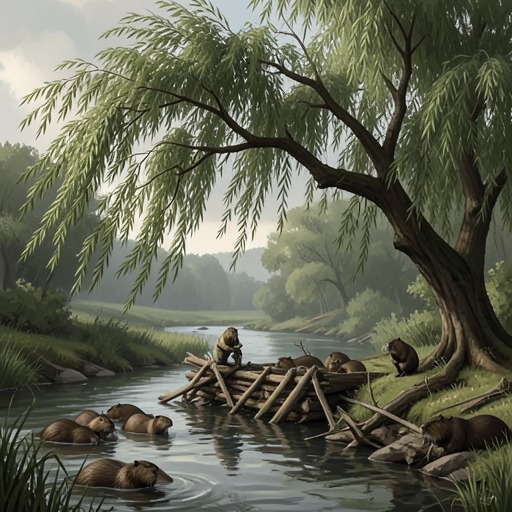
Douglas returned a year later and found the results written into the landscape. The moose were gone, and so were the beavers. Their principal dam had failed without its skilled architects to maintain it, and the lake had drained away. With the water reduced to a tiny creek, none of the large trout remained. The creek threaded through bare, hot ground where the shade had disappeared along with the willows.
The sequence links biological loss to physical change. The spraying killed willows; the beavers disappeared; their dam was no longer maintained; the lake drained; and the remaining creek could not sustain the large trout. The region was not left as the same place with fewer sagebrush plants. Its shade, water, habitat, and wildlife had been altered together. Carson’s description of a shattered living world follows from these concrete changes rather than from an abstract warning about chemicals.
Significance in Carson’s argument
The Bridger episode exemplifies what Carson calls the shotgun approach to nature: a broad intervention that destroys many plants besides the intended target. The immediate agricultural aim was to produce grassland, but the method disregarded ecological relations that made the landscape habitable for other species. Because the willows stood along streams and supported beavers, their destruction set off effects that reached water, trout, moose, and the region’s fishing and hunting.
The account also turns a policy of improvement into a question of what improvement means and for whom. More grazing grass was the stated objective, while the costs appeared in the disappearance of wildlife and in the loss of a lake and shaded creek. By tracing the aftermath from dying willows to an emptied landscape, Carson shows why land cannot be judged only by whether it has been reshaped to suit one human use. In the Bridger National Forest, a measure intended to simplify and increase the land’s utility instead dismantled relationships that had sustained its living community.